Experimental and Theoretical Investigation of Rotary Atomization Dynamics for Control of Lipid Multiparticulate (LMP) Particle Size during Spray Congealing Process
Cody Prather, Christopher Craig, John Baumann, Michael Morgen
Lonza
PURPOSE
Rotary atomization has been employed in the pharmaceutical industry to produce LMPs via the spray congealing process. This process is useful owing to its capacity to effectively process a wide range of formulations, achieve a broad range of release kinetics, and for its ability to controllably produce microspheres of a range of sizes with narrow distributions.
Particle size control is directly related to atomization and is considered a critical-to-quality attribute, i.e., particle size is critical to performance attributes such as the drug release rate and downstream processing.
Therefore, it is critical to understand the rotary atomization dynamics to understand the impacts on particle size and develop a framework to predict and control particle size.
OBJECTIVES
- Gain a fundamental and cohesive understanding of the mechanisms that influence particle size
- Compare the results with respect to previously published works and extract accurate predictive models
- Develop a framework that can be used to design a robust atomization process and control particle size
METHODS
Materials and Sample Preparation
Two pharmaceutically representative model systems were used. Compritol 888 as an inviscid fluid and a mixture of Compritol 888 and Pearlitol 25C Mannitol as a suspension. The samples were created by heating to 85 °C and high-shear mixing.
Equipment
Experiments were conducted on a custom-fabricated, lab-scale melt-spray-congeal (MSC) unit equipped with a rotary disk atomizer to study the process variables of disk speed and flow rate. High speed images of the atomization process were captured with a Phantom v7.3 high-speed camera.
Characterization and Procedures
Representative samples were obtained using a rotary micro-riffler and particle size was analyzed via a Malvern Mastersizer laser diffraction system with the resulting median particle size (Dv50) reported.
RESULTS
Inviscid Fluids
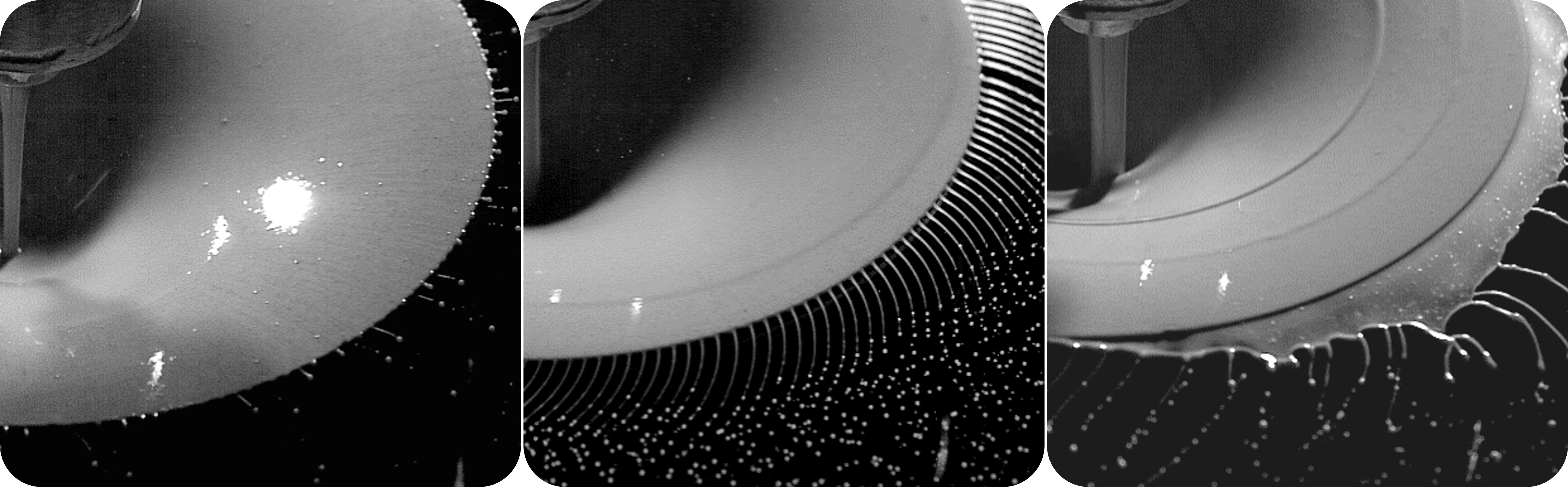
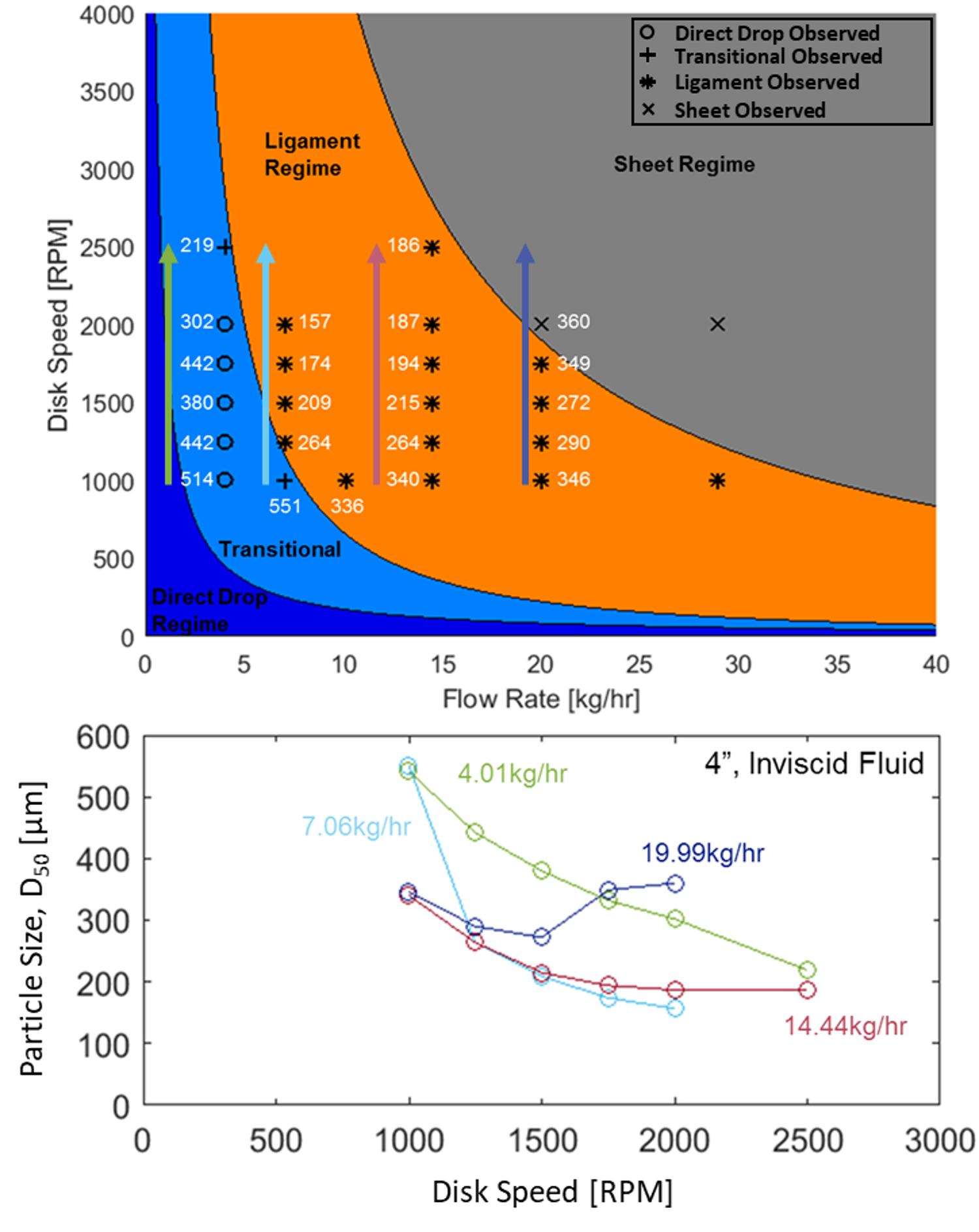
- Figure 1 illustrates the atomization regimes obtained for inviscid fluids promoted by an increase in either disk speed or flow rate
- Figure 2 exhibits the Frost [1] atomization regime space for inviscid fluids overlaid with experimental observations labeled with D50 particle size. In general, the regime predictions are in good agreement, with the exception of the transitional and direct drop regimes.
- Furthermore, the particle size is dependent on the atomization regime. The direct drop regime created droplets larger than those of the ligament regime for a given disk speed, and with a bimodal distribution; whereas the ligament regime created droplets that were uniform and narrow in distribution.
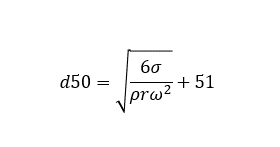
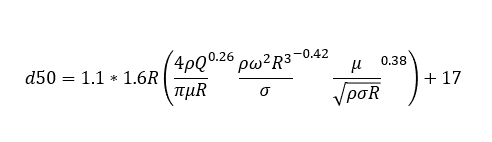
- Lastly, particle size models were developed from existing literature. The particle size for direct drop and ligament regimes can be well predicted by modifying equations from Liu et al. [2] and Kitamura et al. [3] by adding a slope and offset determined by minimizing the error between predicted and actual D50.
- Modified Liu equation for direct drop regime
Modified Kitamura equation for ligament regime
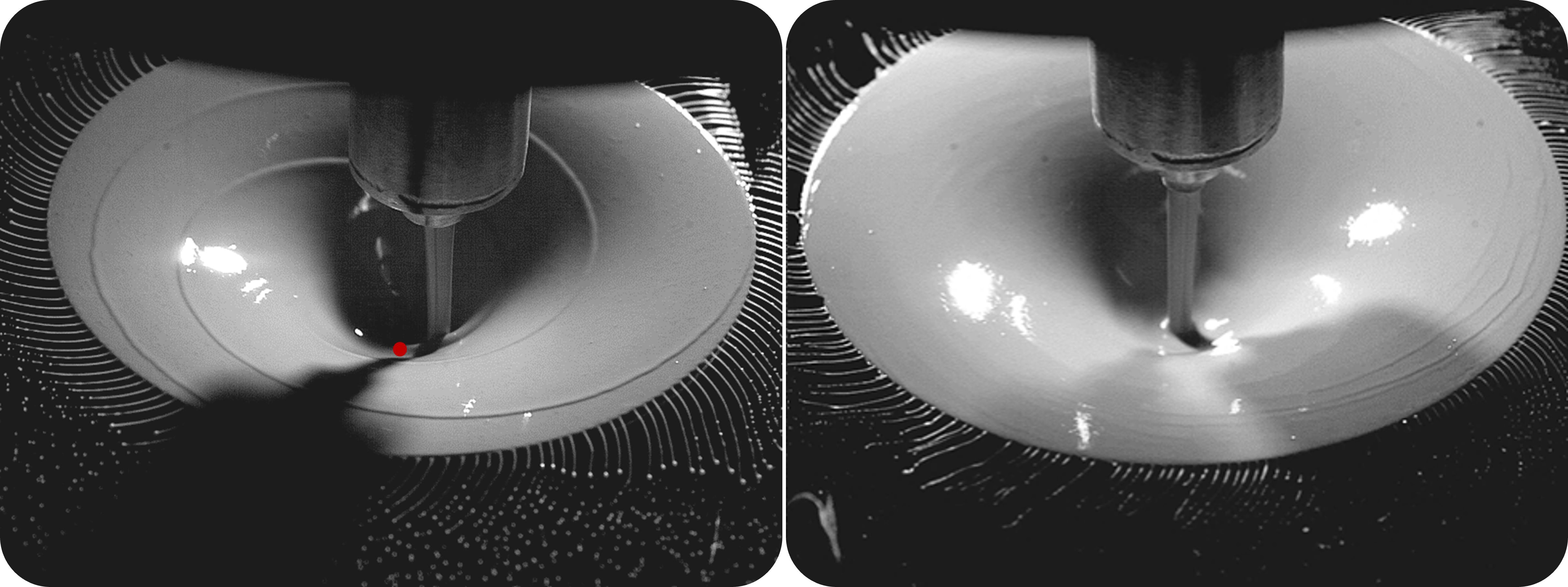
- Illustrated by Figure 3 are the presence of standing and radially propagating wave film instabilities. Standing waves are created when the nozzle is eccentric to the disk center. Radially propagating waves are created by Kelvin–Helmholtz instabilities and observed at the higher disk speeds and flow rates. Both instabilities influence the resultant particle size distribution by creating larger droplets.
- Creating a robust process depends on the mitigation of film instabilities and control of particle size by use of predictive models to optimize the process conditions
Suspensions
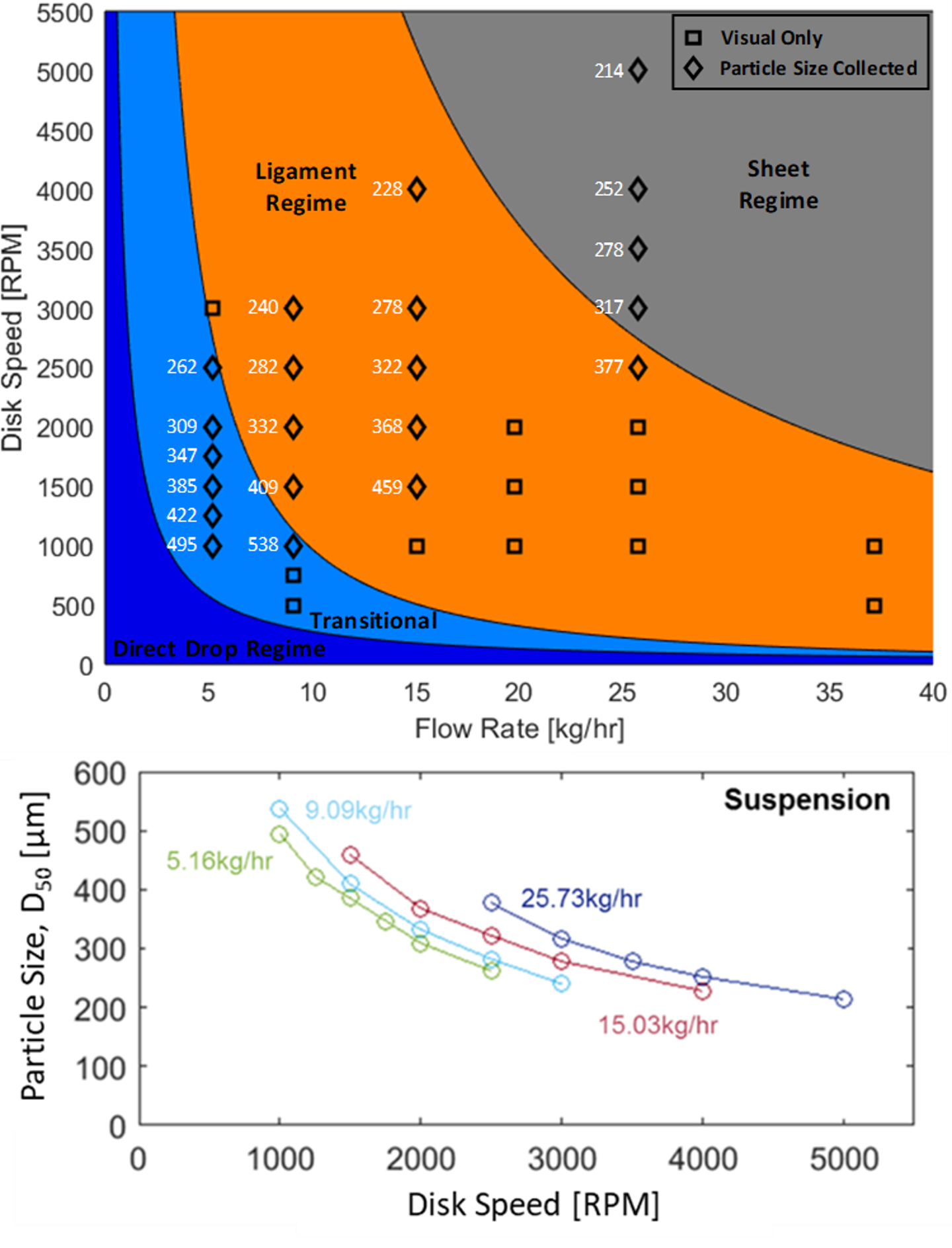
- Figure 4 illustrates the Frost [1] regime predictions overlaid with the experimental results and D50 particle size for suspensions.
- Suspensions don’t encompass the Frost regime space and behave differently than inviscid fluids. The suspended particles aid in the breakup by creating perforations that dominate atomization and thus, effectively suppress the sheet regime and expand the ideal operating space.
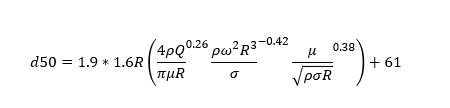
- Furthermore, the particle size can be predicted by a single modified equation from Kitamura et al. [3].
- Processing suspensions is inherently robust as they mitigate film instabilities and significantly increase the ideal operating space
CONCLUSIONS
- The study determined the atomization dynamics and influence on particle size to design a robust process with accurate particle size control
- Atomization regimes were identified and correlated with existing literature
- The ideal operating ranges were identified, and predictive particle size models were developed
- A framework for designing a robust MSC process is derived from the understanding of the atomization dynamics
REFERENCES
- A.R. Frost, Rotary atomization in the ligament formation mode, J. Agric. Eng. Res. 26(1) (1981) 63–78. https://doi.org/10.1016/0021-8634(81)90127-X.
- J. Liu, Q. Yu, Experimental investigation of liquid disintegration by rotary cups, Chem. Eng. Sci. 73 (2012) 44–50. http://dx.doi.org/10.1016/j.ces.2012.01.010.
- Y. Kitamura, T. Takahashi, Atomization of highly viscous liquids by a spinning disk, At. Sprays 2(1) (1992) 61–71. http://dx.doi.org/10.1615/AtomizSpr.v2.i1.50.
Understanding Atomization Dynamics to Design a Robust Process with Particle Size Control
Atomization Regimes for Inviscid fluids
Figure 1
The promotion of atomization regimes from direct drop regime (left) to ligament regime (middle) or from ligament regime to sheet regime (right) can be achieved by increasing either disk rotational speed or flow rate
Film Instabilities in inviscid fluids
Figure 3
Standing waves (left) are a result of an eccentric nozzle and radially propagating waves (right) are created by Kelvin-Helmholtz instabilities. Both increase the particle size distribution.
Atomization regime space: Inviscid fluids
The atomization regimes observed are generally in good agreement with those predicted by Frost [1]. Furthermore, the particle size is dependent, not only on the process conditions but also on the atomization regime. The ligament regime is identified to have the ideal particle size distribution; narrow and uniform.
Figure 2
Atomization regime space: Suspensions
Suspensions don’t encompass the Frost [1] regime space and behave differently than inviscid fluids. The suspended particles aid in the breakup mechanism suppressing the sheet regime and expanding the ideal operating space.
Figure 4
Cody Prather, [email protected], 63045 NE Corporate Pl, Bend OR 97701
DISCLAIMER
All trademarks belong to Lonza or its affiliates or to their respective third party owners. The information contained herein is believed to be correct and corresponds to the latest state of scientific and technical knowledge. However, no warranty is made, either expressed or implied, regarding its accuracy or the results to be obtained from the use of such information and no warranty is expressed or implied.