
Take Your AAV Manufacturing
into the Future
Xcite® AAV Producer Cell Line Technology
A Platform Shift Beyond Transient Transfection
Transient transfection has enabled early AAV development, but it introduces inherent limitations at scale - high cost of goods, supply‑chain dependency on GMP plasmids, process variability, and increasing operational complexity. Manufacturing scalability also remains a limiting factor for broader therapeutic access, with operational challenges driven primarily by reliance on plasmid‑based transient transfection systems.
Xcite® AAV Producer Cell Line (PCL) technology represents a fundamental shift toward a biologics‑style manufacturing model, enabling consistent, scalable AAV production without the need for large-scale GMP plasmids, transfection reagents, or helper virus.
Bending the AAV manufacturing cost curve
Through scalable platform innovation, productivity gains, and analytical insight
Move beyond transient transfection with a stable, scalable AAV producer cell line platform designed for predictable performance, lower complexity, and commercial ready manufacturing.

How Xcite® AAV PCL Technology Works
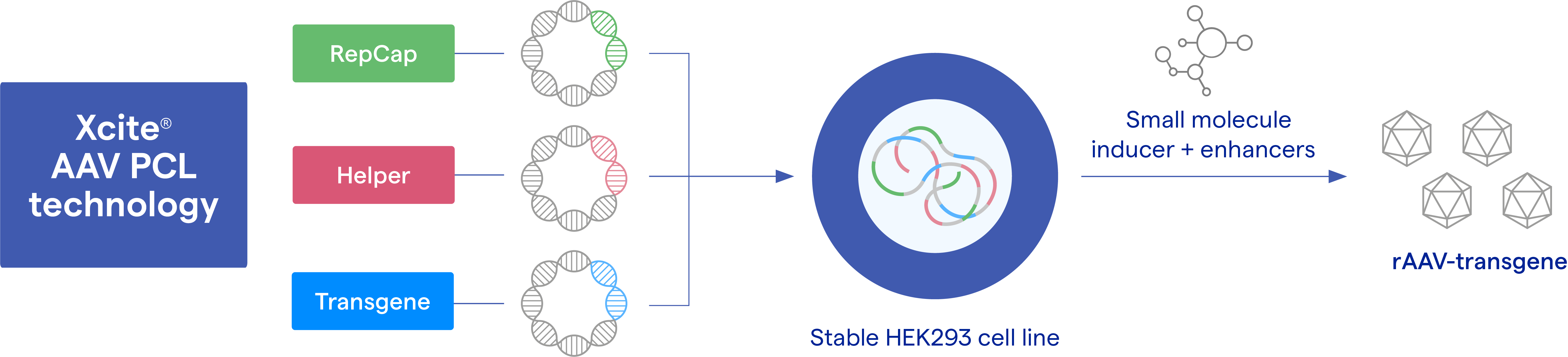
Xcite® AAV PCL stably integrates the genes required for AAV production into Lonza’s proprietary suspension HEK293 clonal cell line. The AAV production is then initiated through small‑molecule chemical induction, eliminating transient transfection steps.
With Xcite® AAV PCL technology, customers can achieve:
- Consistent titers exceeding 1 × 10¹² vg/mL at harvest
- Reproducible productivity across multiple constructs
- Stable performance through extended passaging
- Workflow designed for scalable manufacturing
By eliminating need for large scale GMP plasmids and transfection reagents, Xcite® AAV PCL reduces key cost drivers and enables a more predictable scale‑up.
Next-Generation helper virus-free AAV stable producer cell line (PCL)
On Demand Webinar
Future-proofing your gene therapies with scalable AAV solutions
Discover stable AAV producer cell line approaches achieving titers >1E12 vg/mL with >30% full capsid at harvest, alongside strategies to overcome analytical limitations and enable comprehensive product characterization.
Experts discuss the shift beyond transient transfection and what it enables for scalable AAV manufacturing
As AAV gene therapies expand beyond rare indications, limitations of transient transfection - including cost, variability, and scalability - are emerging as barriers to commercial viability. Stable AAV producer cell lines offer a fundamentally different manufacturing paradigm, but adoption represents a manufacturing process change requiring analytical comparability and, where appropriate, bridging studies aligned with regulatory expectations.
This paper outlines regulatory considerations, timing strategies, and the critical role of robust analytics to support successful PCL transitions.

Panel Discussion
Navigating comparability, bridging studies and regulatory risk
Watch this expert panel discussion on demand to learn how leading teams navigate comparability, regulatory requirements, and scalable AAV manufacturing when transitioning to producer cell line technologies.

Contact our technical experts
For a technical discussion on how Xcite® AAV PCL technology can fit into your workflows, please contact us at [email protected] or submit the contact us form.

